
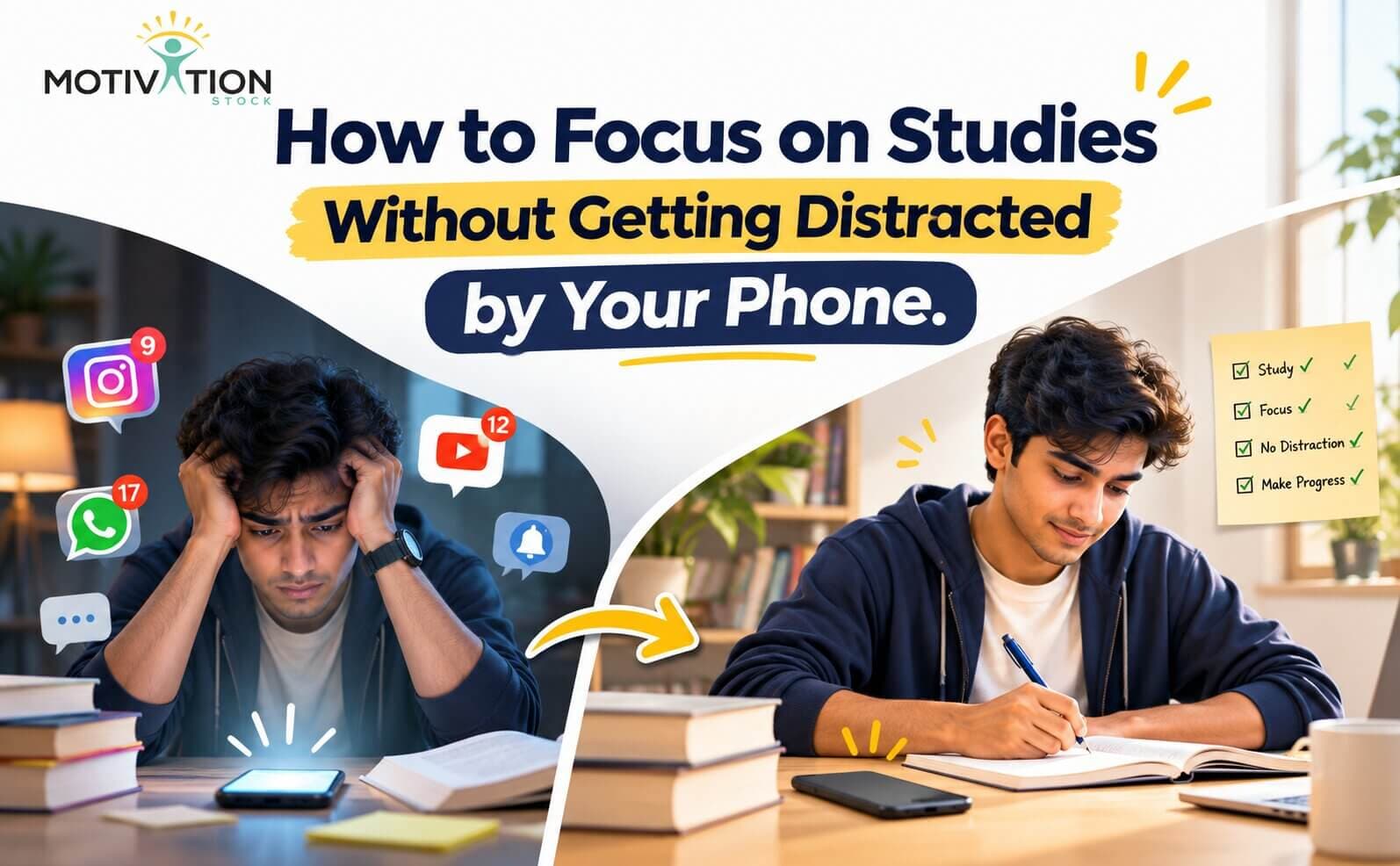
You sit down to study. You open your book, read one line, and your phone lights up. One message turns into one reel, and one reel turns into forty minutes. Now the chapter feels bigger than before, and you feel worse about it.
If this happens to you, you're not lazy and you're not broken. Phones and apps are built to pull you back again and again. Fighting that with willpower alone is a hard fight to win. The good news: you don't need more willpower. You need a few small changes that put distance between you and your phone.
You don't need more willpower. You need more distance between you and your phone.
This guide shows you how to focus on studies without getting distracted by your phone, even if you need it for online classes, PDFs or study groups. Pick two or three ideas, try them this week, and keep what works.
The short answer
To focus on studies without getting distracted by your phone:
- Put your phone in another room while you study, not just face down on the desk.
- Plan your phone breaks so you know when you can check it.
- Turn on Focus mode or Do Not Disturb so only important calls get through.
- Study in short rounds, such as 25 minutes of study and 5 minutes of rest.
- Make your phone boring: log out of distracting apps and move them off your home screen.
- Decide in advance what you'll do when the urge to check comes.
Below, you'll find each step in detail, plus what to do when you need your phone for studying.
Why your phone is so hard to ignore while studying
Studying is hard work for your brain. Reading a tough chapter or solving a long problem feels slow and a little uncomfortable. Your phone offers the opposite: something quick, new and easy, one tap away. So when studying gets hard, your hand reaches for the phone almost on its own.
Nir Eyal, author of Indistractable, puts it simply: most distraction starts with a feeling we want to escape, such as boredom, stress or worry about a test. The phone isn't only the problem. It's the easiest way out of a feeling.
Even a silent phone can pull at your attention. In a well-known 2017 study from the University of Texas at Austin, people did better on memory and thinking tests when their phone was in another room than when it was on the desk, even when it was turned face down and silent. Later studies suggest the effect may be smaller than first reported, but the lesson is easy to try: out of sight works better than out of reach.
10 ways to avoid phone distractions while studying
1. Put your phone in another room
This is the single most useful step. If your phone is on your desk, you'll check it. If it's in your bag, you'll still think about it. If it's in another room, checking it takes effort, and that small effort is often enough to stop you.
No other room? Give your phone to a parent, sibling or roommate for the length of one study session. Or put it in a drawer across the room, behind you, where you can't see it.
2. Plan your phone breaks before you start
Part of the pull comes from not knowing when you'll next see your phone. So decide it in advance. For example: "I'll check my phone at 7:30 and 8:30, for five minutes each time."
Write the times on a sticky note. When you feel the urge, look at the note instead of the phone. Waiting is much easier when you know the wait has an end.
3. Turn on Focus mode or Do Not Disturb
Most phones can silence everything except the people who really matter.
- iPhone: open Settings, then Focus. Create a "Study" Focus that allows calls from family only and hides app notifications.
- Android: open Settings, then Digital Wellbeing and parental controls, and set up Focus mode. Choose the apps to pause while you study.
Set it up once and switching it on takes a single tap each time you sit down to study.
4. Use an app to stop using your phone while studying
If you keep breaking your own rules, let your phone help you keep them.
- App limits: iPhone Screen Time and Android Digital Wellbeing both let you set a daily limit on apps like Instagram or YouTube.
- Focus timer apps: apps such as Forest grow a small tree while you study and stop it growing if you leave the app. It sounds silly, but a visible reward helps many students.
Start with what's already built into your phone. It's free, and you don't add one more app to check.
5. Make your phone boring
Your phone is hard to put down partly because it's so easy to open the fun stuff. Add a little friction:
- Move social media and game apps off your home screen, into a folder on the last page.
- Log out of Instagram, Snapchat or games during exam season, so getting back in takes a password.
- Turn on grayscale (in your phone's accessibility or Bedtime mode settings). A grey screen is much less tempting.
Small steps like these work because they change your defaults. We explain the idea in Your phone isn't the problem. Your defaults are.
6. Study in short rounds
Two hours of study can feel endless, so your brain looks for an escape. Twenty-five minutes feels doable.
The Pomodoro Technique, created by Francesco Cirillo, works like this: study for 25 minutes, rest for 5, and after four rounds take a longer break of 15 to 30 minutes. Use a kitchen timer or a clock, not your phone, so you aren't tempted the moment the timer rings.
Use your short breaks to stand up, drink water or look out of a window. Save the phone for the longer break, or for the times you planned in step 2.
7. Write an if-then plan for the urge
The urge to check your phone will come. Instead of hoping it won't, plan what you'll do when it does. Psychologists call these "if-then plans":
- If I want to check my phone, then I'll write the thought on a scrap of paper and get back to my question.
- If I feel stuck on a problem, then I'll mark it and move to the next one.
Keeping a "later" list helps a lot. Wondering about a message, a cricket score or a video? Write it down. You can look it up during your break, and your mind can let it go for now.
8. Get everything ready before you sit down
Many phone checks start with a real reason: the time, a formula, a date, a doubt. Then you land on a notification and the reason is forgotten.
Before each session, keep a watch or clock nearby, along with your notes, formulas, water and snacks. If you study from PDFs or recorded lectures, download them where the app allows it, so you can study offline.
9. If you need your phone for studying, give it one job
Many students need their phone for online classes, coaching apps, PDFs or class WhatsApp groups. Putting it in another room isn't always possible. In that case:
- Use a bigger screen if you can. A laptop, tablet or printout is less tempting than a phone.
- Open only the study app. Close everything else before you start.
- Turn on airplane mode if you're reading downloaded material.
- Mute busy groups. Mute class or coaching groups and check them only at your planned break times. Important updates will still be there.
- Watch lectures at a desk, not in bed. Where you sit changes what you end up doing.
10. Tell someone, or study together
It's easier to keep a promise you've said out loud. Tell a friend, parent or sibling: "I'm studying until 8 without my phone." Better still, study with a friend who has the same goal. Put both phones in one box and see who wants to open it first.
A simple 2-hour study routine without your phone
Here's one way to put the steps together. Change the times to fit your day.
- 5 minutes, set up: get water, notes, a clock and a "later" list. Write down what you'll finish today.
- Phone away: turn on Focus mode, then put your phone in another room.
- 25 minutes, study: one topic or one set of questions only.
- 5 minutes, break: stretch, drink water, look outside. No phone.
- Repeat for four rounds.
- 20 minutes, long break: now you can check your phone. Set a timer so the break doesn't grow.
If two hours is too much right now, start with a single round. As we say in The two-minute start, the hardest part is beginning. Once you start, it's easier to keep going.
How to focus on studies for long hours
Focus is like a muscle. You build it slowly. If you can only study for 15 minutes without your phone today, that's your starting point, and that's fine.
- Week 1: 25-minute rounds, phone in another room.
- Week 2: 35 to 40-minute rounds.
- Week 3 onward: 50-minute rounds with 10-minute breaks, if they feel right.
Do your hardest subject in your first round, when your mind is fresh. Save easy tasks, like making notes neat, for later. For a structured way to build longer focus, try our free 7-Day Deep Work Challenge, based on ideas from Cal Newport's Deep Work.
What to do when you slip
You will slip. Everyone does. You'll pick up your phone "for one second" and lose half an hour. That doesn't mean the plan failed.
When it happens, don't waste more time feeling guilty. Put the phone back in the other room, take one slow breath, and start a fresh 25-minute round. One lost round is a small thing. Giving up for the whole evening is the bigger loss.
Afterwards, ask yourself one kind question: what pulled me away? A notification? A hard problem? Tiredness? The answer tells you which step to try next.
You don't need more willpower. You need more distance between you and your phone.
Questions students ask
How do I stop phone addiction and focus on studies?
Start by making your phone harder to reach, not by trying to quit it completely. Keep it in another room while you study, turn off notifications from apps, log out of the apps you scroll most, and plan short phone breaks. Small changes you can keep work better than a strict ban you break after two days. If you feel you can't control your phone use at all, or it's affecting your sleep and mood, talk to a parent, teacher or counsellor.
What is the best app to stop using my phone while studying?
Start with the free tools already on your phone: Screen Time on iPhone and Digital Wellbeing on Android. Both can limit apps and silence notifications. If you want a visible reward for staying focused, a focus timer app like Forest can help. The best app is the one you actually switch on each time you study.
How can I study without distractions at home?
Choose one study spot, ideally a desk, not your bed. Keep your phone in another room, tell family when you're studying, and keep everything you need within reach before you start. Short rounds of 25 minutes with planned breaks make it easier to stay on task in a busy home.
Is it okay to listen to music on my phone while studying?
It depends on you. Some students focus better with quiet music without words, while others find any music distracting. If you use your phone for music, make a playlist before you start, turn on Focus mode, and put the phone face down out of reach so you don't keep changing songs.
How long does it take to stop reaching for my phone?
It varies from person to person. In a study from University College London, new habits took an average of 66 days to feel automatic, with a wide range between people. Most students notice a difference within the first week of keeping their phone in another room. Be patient and count the sessions you get right, not the ones you miss.
Start with one session today
You don't have to do all ten steps. Tonight, try just one: put your phone in another room and study for 25 minutes. That's it. Tomorrow, do it again.
Want to see your progress? Add "Study 25 minutes without my phone" to our free online habit tracker and tick it off each day. If you want to cut your screen time beyond study hours too, try our gentle 7-day digital detox.
Small brave steps add up. One focused session at a time.